2GB max RAM · 4 bays · 1GbE
AINAS Score 12
No verified UK price
View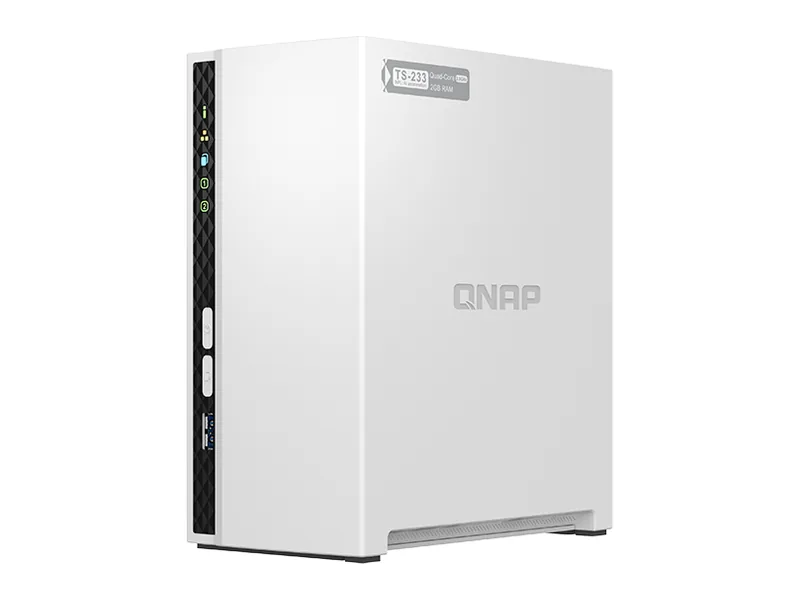
Can the QNAP TS-233 run local AI?
No. The QNAP TS-233 is a storage-first Traditional NAS: ARM Cortex-A55 quad-core 2.0GHz and at most 2GB of memory leave no room for a local language model.
It is here as a reference point against systems that can run AI.
The TS-233 is a budget two-bay NAS for basic backup and file sharing, and we list it as a Traditional NAS. Its quad-core ARM processor and 2GB of fixed memory rule out local language models entirely, and QNAP's own Ollama guidance targets x86 systems with 8GB or more.
It does have one AI trick. The chip includes a small NPU that QNAP uses to speed up face and object recognition in QuMagie, so a family photo library gets sorted locally without the cloud. That is useful, but it is image tagging, not general AI.
Buy it if you want a simple, low-power box for phone backups and shared folders and do not plan to run apps beyond QNAP's own. If you are reading this page because you want private AI at home, it is the wrong starting point; even an entry x86 model such as the TS-264 gives you far more room.
Amazon UK
TS-233 (2GB)
£238
Verified
In stock
View dealProduct prices and availability are accurate as of the date/time indicated and are subject to change. Any price and availability information displayed on Amazon.co.uk at the time of purchase will apply to the purchase of this product.
Each capability shows how it was confirmed: Verified by AINAS, Vendor confirmed, Community confirmed or Unverified.
| Capability | Supported | Evidence | Note |
|---|---|---|---|
| Local LLM | No | Vendor confirmed | QNAP Ollama guide targets x86_64 with 8GB+ RAM; only a few ARM models supported. 2GB fixed RAM. |
| Ollama | No | Vendor confirmed | Guide requires x86_64 and 8GB+ for 3B models; not viable on 2GB ARM. |
| Open WebUI | No | Vendor confirmed | Open WebUI guide requires Ollama on the same NAS. |
| RAG | No | Unverified | Qsirch is listed but no RAG support documented for this ARM model. |
| AI search | No | Vendor confirmed | Qsirch AI Semantic Search requires 64-bit x86 and 8GB RAM. |
| GPU expansion | No | Vendor confirmed | No PCIe slot. |
| Hardware acceleration | Yes | Vendor confirmed | Hardware transcoding and built-in NPU listed (TOPS not published). |
| AI photos | Yes | Vendor confirmed | Built-in NPU accelerates QNAP AI Core face and object recognition in QuMagie. |
| AI video | No | Vendor confirmed | QVR Face requires Intel/AMD CPU; ARM support cited only for TS-AI642. |
| Surveillance AI | Yes | Vendor confirmed | QVR Surveillance: 2 free channels, register to claim 6 more. |
Memory on the TS-233 is fixed at 2GB of memory. There are no slots to add more, so choose the largest configuration you can justify on day one.
There is no supported way to add a GPU to the TS-233: no PCIe slot and no OCuLink. Inference runs on the CPU, with Mali-G52 handling media tasks, so keep to small models.
Not well. A useful private RAG setup needs more memory or compute than the TS-233 offers.
Built-in networking: 1GbE. Adequate for a household, slower for bulk indexing.
| Configuration | RAM | SSD | Notes |
|---|---|---|---|
| TS-233 (2GB) | 2GB | None | Single configuration; memory not expandable |
The closest QNAP model by AINAS Score. Only the specifications that differ are listed.
Its strongest AINAS profiles are Business at 15 and Home Lab at 14, which points to small offices that need shared storage with private AI tools and room to grow.
Look elsewhere if you are anyone who wants to run models larger than about 8B parameters, or buyers who expect to add a graphics card later.
Other Traditional NAS systems closest in price.
No. Ollama support is documented by the manufacturer. See the capability table above for the source.
No. Open WebUI support is documented by the manufacturer. See the capability table above for the source.
Yes. AI photos support is documented by the manufacturer. See the capability table above for the source.
Yes. Surveillance AI support is documented by the manufacturer. See the capability table above for the source.
Yes. Hardware acceleration support is documented by the manufacturer. See the capability table above for the source.
It has 1GbE built in. The fastest port is 1GbE.
Every field records its source. Specifications were last checked on . Spot an error? Send a correction with a manufacturer link.