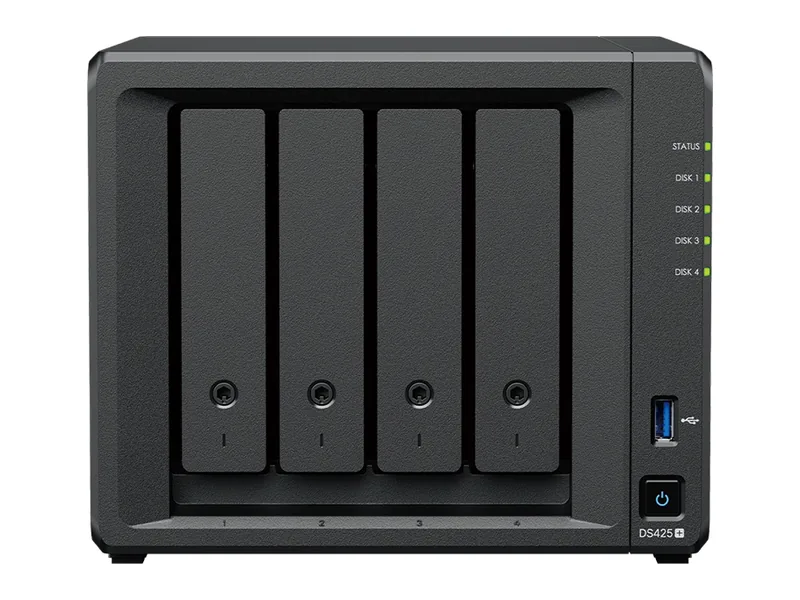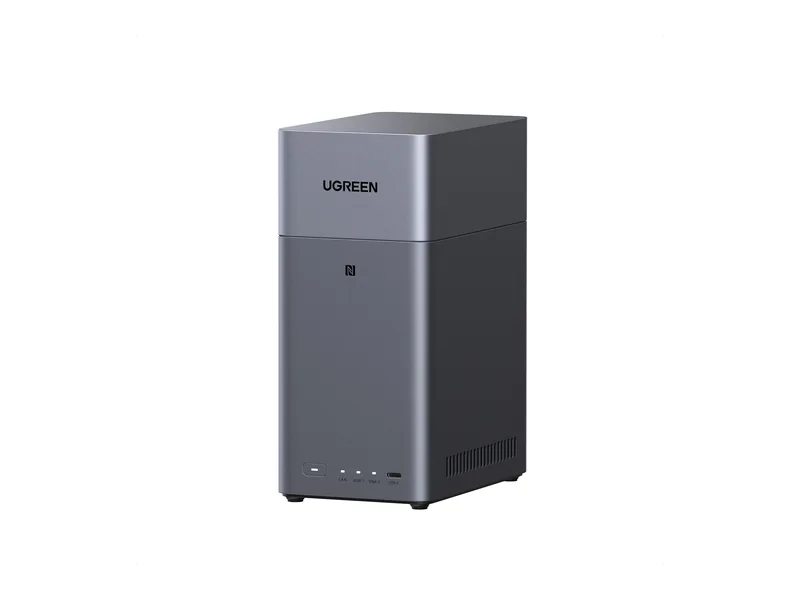
4GB max RAM · 2 bays · 1GbE
AINAS Score 22
£159.99£219.99
Amazon UK · Verified
Traditional NASOWC
Why Traditional NAS: Dual Intel Xeon Scalable (model unpublished) with no documented GPU path and a 512GB memory ceiling, but OWC documents no Docker or container support, so the no Docker rule makes it traditional.
Updated
Can the OWC Jellyfish Tower run local AI?
Not in any useful way. Dual Intel Xeon Scalable (model not published) with 512GB of memory at most makes the OWC Jellyfish Tower a backup and file-sharing box, which is why we class it as a Traditional NAS.
Use it as a baseline when comparing AI-capable alternatives.
The Jellyfish Tower suits video teams that want a closed shared-storage appliance and have no plans to run AI software on it. It has dual Intel Xeon Scalable processors (model not published), 256GB of DDR4 memory with a 512GB maximum, a 1000W power supply and two 1GbE ports. It is managed through Jellyfish Manager, an appliance OS whose underlying name is not published. Configurations are listed at 120TB, 240TB and 480TB, each with 256GB of memory. It holds an AINAS Score of 28, which reflects its role as a storage box rather than an AI machine.
The main thing that rules it out is that it cannot run model software. OWC documents no Docker or container support, and the local LLM row says no, so memory would hold a model but nothing on the system can run it. That affects anyone who wants local LLMs, private RAG or AI search on their storage. Those buyers should look for documented container support, a confirmed GPU path or an NPU, memory they can expand, and a local LLM row that is verified rather than unconfirmed. Networking also stops at 1GbE, so check the ports against your workflow.
No verified price
We have not verified a listing for the OWC Jellyfish Tower at a retailer we track. The specifications below stand on their own; a price appears here as soon as a listing is confirmed.
Product prices and availability are accurate as of the date/time indicated and are subject to change. Any price and availability information displayed on Amazon.co.uk or Amazon.com, as applicable, at the time of purchase will apply to the purchase of this product.
Each capability shows how it was confirmed: Verified by AINAS, Vendor confirmed, Community confirmed or Unverified.
| Capability | Supported | Evidence | Note |
|---|---|---|---|
| Local LLM | No | Unverified | No Docker, container or LLM support documented by OWC; closed video storage appliance. |
| Ollama | No | Unverified | No evidence found. |
| Open WebUI | No | Unverified | No evidence found. |
| RAG | No | Unverified | No evidence found. |
| AI search | No | Unverified | No AI search feature documented. |
| GPU expansion | No | Unverified | No GPU path documented. |
| Hardware acceleration | No | Unverified | No GPU or accelerator documented. |
| AI photos | No | Unverified | No feature documented. |
| AI video | No | Unverified | No AI video feature documented. |
| Surveillance AI | No | Unverified | No feature documented. |
Calculated from the Jellyfish Tower's memory and each model's published size at each quantization. Rows marked Estimated are calculations, not benchmarks. Check any model.
| Model | Best quantization | Runs? | Memory needed | Expected performance | Verification |
|---|---|---|---|---|---|
| Llama 3.2 3BLlama, 3.21B | Q8 | Yes | 13GB | Not measured | Estimated |
| Llama 3.1 8BLlama, 8.03B | Q8 | Yes | 19GB | Not measured | Estimated |
| Qwen3 8BQwen, 8.19B | Q8 | Yes | 19GB | Not measured | Estimated |
| Gemma 3 12BGemma, 11.8B | Q8 | Yes | 24GB | Not measured | Estimated |
| Qwen3 14BQwen, 14.8B | Q8 | Yes | 28GB | Not measured | Estimated |
| Phi-4 14BPhi, 14.7B | Q8 | Yes | 28GB | Not measured | Estimated |
| Mistral Small 3 24BMistral, 23.6B | Q8 | Yes | 38GB | Not measured | Estimated |
| Gemma 3 27BGemma, 27B | Q8 | Yes | 44GB | Not measured | Estimated |
| Qwen3 30B A3BQwen, 30.5B | Q8 | Yes | 47GB | Not measured | Estimated |
| Qwen3 32BQwen, 32.8B | Q8 | Yes | 50GB | Not measured | Estimated |
| DeepSeek-R1 32B (Qwen distill)DeepSeek, 32.8B | Q8 | Yes | 50GB | Not measured | Estimated |
| Llama 3.3 70BLlama, 70.6B | Q8 | Yes | 98GB | Not measured | Estimated |
| Llama 4 Scout 17Bx16ELlama, 109B | Q8 | Yes | 149GB | Not measured | Estimated |
| Qwen2.5 72BQwen, 72.7B | Q8 | Yes | 101GB | Not measured | Estimated |
| Mistral Large 2 123BMistral, 123B | Q8 | Yes | 164GB | Not measured | Estimated |
One verdict per workload, from the Jellyfish Tower's use-case scores and capability rows. Unknown means we cannot confirm it, not that it probably works.
The Jellyfish Tower is a poor choice for running local language models. OWC documents no Docker, container or LLM support, and the local LLM and Ollama rows both say no, though both are Unverified.
Private RAG is a poor fit here. The RAG, Open WebUI and Ollama rows all say no with no evidence found, and none is verified, so nothing on the system is confirmed to run a retrieval stack.
AI search is a poor fit. OWC documents no AI search feature for the Jellyfish Tower, so the row says no, and that row is Unverified rather than confirmed either way.
AI photo features are a poor fit. The AI photos row says no because no feature is documented, and it is marked Unverified, so do not expect photo recognition from this system.
Surveillance is a poor fit. No surveillance feature is documented for the Jellyfish Tower, and the row says no while remaining Unverified, so camera recording or detection is not confirmed.
We cannot confirm whether the Jellyfish Tower suits a home lab. Docker and virtual machine support are not published, and the appliance OS is not named, so there is nothing to base a judgement on.
Business use is rated poor. It is a closed video storage appliance with two 1GbE ports and no documented AI features, and ECC memory support is not stated.
Creative AI work is a poor fit. GPU expansion is none, no accelerator is documented, and the local LLM row says no, all Unverified, so generative tools have no confirmed path.
Plan on upgrading. 256GB is fitted as standard, while the Jellyfish Tower accepts 512GB of DDR4, which is the difference between 70B class models at higher-quality quantization, or large mixture-of-experts models at 4-bit and 70B class models at higher-quality quantization, or large mixture-of-experts models at 4-bit (Estimated).
Our estimate for the biggest model that fits in 512GB is about 840B parameters at 4-bit, after setting aside 8GB for the system. Long context windows reduce that figure (Estimated).
A graphics card is not an option on the Jellyfish Tower, which has neither a PCIe slot nor OCuLink. Inference runs on the CPU, so keep to small models.
Not well. A useful private RAG setup needs more memory or compute than the Jellyfish Tower offers.
For network access it has 2 x 1GbE. Enough for light use; large imports will take a while.
| Configuration | RAM | SSD | Notes |
|---|---|---|---|
| 120TB, 256GB | 256GB | None | |
| 240TB, 256GB | 256GB | None | |
| 480TB, 256GB | 256GB | None |
The closest OWC model by bay count and AINAS Score. Only the specifications that differ are listed.
Best fit: people who want a private chat assistant or coding model at home without sending data to a cloud service. That is where the Jellyfish Tower scores highest (Local LLM 42/100), followed by RAG (37/100).
Less suited to buyers who expect to add a graphics card later and teams moving large files over the network every day.
Other Traditional NAS systems closest in overall score.
No. The Jellyfish Tower cannot run model software, so nothing on it can run any model. Memory alone would hold the 142GB that Qwen3 235B A22B needs at Q4 (Estimated), against 256GB included and a 512GB maximum, but OWC documents no Docker or container support and the local LLM row says no. Treat that figure as a memory calculation, not a capability.
256GB is included, and the maximum is 512GB. The memory type is DDR4. All three listed configurations ship with 256GB. Whether the memory can be expanded by the buyer is not published, and ECC support is not stated, so check both with OWC before planning an upgrade.
No Docker support is documented. OWC publishes no container support, and several searches of its site found no mention. That is an absence of evidence rather than a stated no, but it is why the system is classed as traditional rather than built for AI. Treat Docker as unconfirmed.
No. OWC documents no GPU path, the PCIe slot layout is not published, and there is no OCuLink, Thunderbolt or USB4 port, so there is no confirmed way to attach a card. GPU expansion and hardware acceleration are marked no and Unverified, and no integrated GPU, NPU or accelerator is listed. Without documented container support, no model software could use a card anyway. The dual Xeon Scalable processors and the 1000W power supply serve the storage appliance.
Three configurations are listed: 120TB, 240TB and 480TB, each with 256GB of memory. All three use dual Intel Xeon Scalable processors, a 1000W power supply and two 1GbE ports, so capacity is the only difference between them. The memory can go up to 512GB.
No. The Jellyfish Tower has no Thunderbolt or USB4 ports. Its network connection is two 1GbE ports. The manual describes Thunderbolt only on the client side, through an external OWC Thunderbolt 3 10G Ethernet adapter, not on the system itself.
No. Ollama support is not yet verified. See the capability table above for the source.
No. Open WebUI support is not yet verified. See the capability table above for the source.
No. AI photos support is not yet verified. See the capability table above for the source.
No. Surveillance AI support is not yet verified. See the capability table above for the source.
No. Hardware acceleration support is not yet verified. See the capability table above for the source.
It has 2 x 1GbE built in. The fastest port is 1GbE.