96GB max RAM · 16 bays · 2 x 10GbE
AINAS Score 50
No verified price
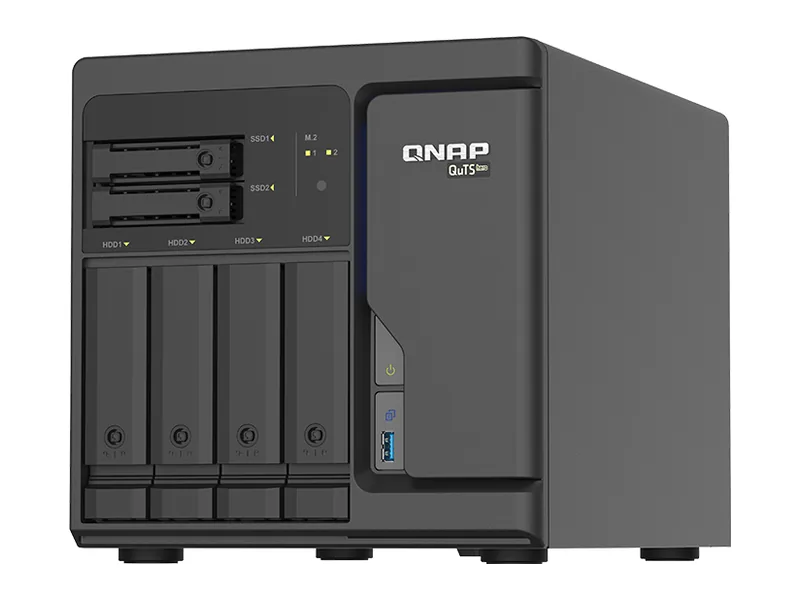
AI CapableQNAPDiscontinued
Why AI Capable: Xeon D-1602 (2 cores, 2019) is not a current CPU, and QNAP's GPU list for its PCIe slot stops at a 4GB GTX 1650.
Updated
Can the QNAP TS-h686 run local AI?
Only lightly. Expect 70B class models at higher-quality quantization, or large mixture-of-experts models at 4-bit (Estimated) on the QNAP TS-h686: Intel Xeon D-1602 (2-core/4-thread, up to 3.2 GHz) does the work with up to 128GB of memory, which is fine for experiments rather than a daily assistant.
Its PCIe x8 slot leaves room to add a GPU when you outgrow CPU inference.
Local LLM support is documented by the manufacturer.
The TS-h686 suits a buyer who wants a six-bay QNAP that can also host local models and has room to grow. It takes up to 128GB of DDR4 ECC UDIMM memory, and the memory is expandable. It has 4 x 2.5GbE, 2 M.2 NVMe slots and two PCIe Gen3 x8 slots. Container Station covers Docker, and Ollama and Open WebUI are both vendor confirmed. At 128GB, Mistral Large 2 123B fits at Q4 (Estimated). Qwen3 32B fits at both Q4 and Q8 (Estimated). The AINAS Score is 53. Surveillance and QuMagie photo management are vendor confirmed, and the warranty is 3 years.
The main issue is processing power. The TS-h686 has a 2-core Xeon D-1602 and no NPU or integrated graphics. QNAP's official GPU list for the PCIe slots stops at a 4GB GTX 1650, and the vendor notes describe CPU inference as slow despite the memory. Buyers who want responsive large models should look for a system with a current multi-core CPU, a GPU path with much more video memory, or an NPU with a stated TOPS figure. QNAP has also discontinued the TS-h686, and its only variant is marked end of life, which matters to anyone who wants years of vendor support.
No verified price
We have not verified a listing for the QNAP TS-h686 at a retailer we track. The specifications below stand on their own; a price appears here as soon as a listing is confirmed.
Product prices and availability are accurate as of the date/time indicated and are subject to change. Any price and availability information displayed on Amazon.co.uk or Amazon.com, as applicable, at the time of purchase will apply to the purchase of this product.
Each capability shows how it was confirmed: Verified by AINAS, Vendor confirmed, Community confirmed or Unverified.
| Capability | Supported | Evidence | Note |
|---|---|---|---|
| Local LLM | Limited | Vendor confirmed | QNAP Ollama guide applies (x86). 2-core Xeon D and 4GB max listed GPU: slow CPU inference despite 128GB RAM. |
| Ollama | Yes | Vendor confirmed | Container Station Ollama tutorial for x86 QTS/QuTS hero NAS. |
| Open WebUI | Yes | Vendor confirmed | QNAP Open WebUI tutorial, QTS 5.2 / QuTS hero h5.2+. |
| RAG | Limited | Unverified | Qsirch RAG Search (beta) exists; not confirmed for this model. |
| AI search | Limited | Unverified | x86 with 8GB meets AI Semantic Search minimum; whether x86 series counts as x74 or above for AI Semantic Index is not stated. |
| GPU expansion | Limited | Vendor confirmed | Two PCIe Gen3 x8 slots, 250W PSU; official list tops out at GTX 1650 4GB. |
| Hardware acceleration | Limited | Vendor confirmed | No iGPU; hardware transcoding only via optional PCIe GPU. No AI accelerator category on compatibility list. |
| AI photos | Yes | Vendor confirmed | QuMagie AI-assisted photo management. |
| AI video | Yes | Vendor confirmed | QVR Face and QVR Human listed under QTS. |
| Surveillance AI | Yes | Vendor confirmed | QVR Surveillance 2 free + 6 on registration; QVR Pro 8 free (QTS). |
Calculated from the TS-h686's memory and each model's published size at each quantization. Rows marked Estimated are calculations, not benchmarks. Check any model.
| Model | Best quantization | Runs? | Memory needed | Expected performance | Verification |
|---|---|---|---|---|---|
| Llama 3.2 3BLlama, 3.21B | Q8 | Yes | 13GB | Not measured | Estimated |
| Llama 3.1 8BLlama, 8.03B | Q8 | Yes | 19GB | Not measured | Estimated |
| Qwen3 8BQwen, 8.19B | Q8 | Yes | 19GB | Not measured | Estimated |
| Gemma 3 12BGemma, 11.8B | Q8 | Yes | 24GB | Not measured | Estimated |
| Qwen3 14BQwen, 14.8B | Q8 | Yes | 28GB | Not measured | Estimated |
| Phi-4 14BPhi, 14.7B | Q8 | Yes | 28GB | Not measured | Estimated |
| Mistral Small 3 24BMistral, 23.6B | Q8 | Yes | 38GB | Not measured | Estimated |
| Gemma 3 27BGemma, 27B | Q8 | Yes | 44GB | Not measured | Estimated |
| Qwen3 30B A3BQwen, 30.5B | Q8 | Yes | 47GB | Not measured | Estimated |
| Qwen3 32BQwen, 32.8B | Q8 | Yes | 50GB | Not measured | Estimated |
| DeepSeek-R1 32B (Qwen distill)DeepSeek, 32.8B | Q8 | Yes | 50GB | Not measured | Estimated |
| Llama 3.3 70BLlama, 70.6B | Q8 | Yes | 98GB | Not measured | Estimated |
| Llama 4 Scout 17Bx16ELlama, 109B | Q4 | Yes | 89GB | Not measured | Estimated |
| Qwen2.5 72BQwen, 72.7B | Q8 | Yes | 101GB | Not measured | Estimated |
| Mistral Large 2 123BMistral, 123B | Q5 | Yes | 112GB | Not measured | Estimated |
One verdict per workload, from the TS-h686's use-case scores and capability rows. Unknown means we cannot confirm it, not that it probably works.
The TS-h686 is an acceptable local LLM host, with caveats. Local LLM support is marked limited and vendor confirmed, and the notes say a 2-core Xeon D and a 4GB maximum listed GPU mean slow CPU inference.
Private RAG is workable on the TS-h686, with a gap. Ollama and Open WebUI are vendor confirmed, but Qsirch RAG Search (beta) is limited and Unverified, so it is not confirmed for this model.
We cannot confirm AI search on the TS-h686. The capability is limited and Unverified, and it is not stated whether this x86 series meets the requirement for the AI Semantic Index, though 8GB meets the minimum for AI Semantic Search.
AI photo management is a reasonable fit for the TS-h686. QuMagie, QNAP's AI-assisted photo manager, is listed for this model and is vendor confirmed.
Surveillance is a reasonable use for the TS-h686. QVR Surveillance includes 2 free licences plus 6 on registration, QVR Pro includes 8 free under QTS, and QVR Face and QVR Human are listed. All are vendor confirmed.
The TS-h686 works as a home lab server. It supports Docker and virtual machines, takes up to 128GB of ECC memory, and has 6 bays, 2 M.2 slots and 4 x 2.5GbE ports.
The TS-h686 is an acceptable business file server. It has ECC memory, QuTS hero, 6 drive bays and a 3 year warranty, but it is discontinued and has only a 2-core CPU.
Creative AI is possible on the TS-h686 but limited by the GPU path. GPU expansion is limited and vendor confirmed, with two PCIe Gen3 x8 slots and an official list that tops out at a GTX 1650 4GB.
Plan on upgrading. 8GB is fitted as standard, while the TS-h686 accepts 128GB of DDR4 ECC UDIMM, ECC included, which is the difference between small models up to around 7B parameters and 70B class models at higher-quality quantization, or large mixture-of-experts models at 4-bit (Estimated).
Our estimate for the biggest model that fits in 128GB is about 200B parameters at 4-bit, after setting aside 8GB for the system. Long context windows reduce that figure (Estimated).
ECC memory support is a plus for always-on systems that also hold important files.
Yes, through a Slot 1 PCIe Gen3 x8 (260 x 111.15 mm) + Slot 2 PCIe Gen3 x8 (150 x 68.9 mm). That is the single biggest upgrade for local AI on the TS-h686: model layers move into fast graphics memory and replies speed up dramatically. Card size and power are the constraints (250W supply).
As the storage half of a RAG setup it works well; as the model host it is limited. Small embedding models run fine on the TS-h686, while the answering model needs more compute than it has.
For network access it has 4 x 2.5GbE. Enough for light use; large imports will take a while.
| Configuration | RAM | SSD | Notes |
|---|---|---|---|
| TS-h686-D1602-8G | 8GB | None |
The closest QNAP model by bay count and AINAS Score. Only the specifications that differ are listed.
Best fit: people who want a private chat assistant or coding model at home without sending data to a cloud service. That is where the TS-h686 scores highest (Local LLM 59/100), followed by RAG (59/100).
Less suited to teams moving large files over the network every day and buyers who want a model with a long support life ahead.
Other AI Capable systems closest in overall score.
Yes at Q4, as an estimate. Mistral Large 2 123B needs 73GB at Q4, which fits within the 128GB maximum (Estimated). At Q8 it needs 130GB, so it does not fit (Estimated). The vendor notes warn of slow CPU inference, because the processor is a 2-core Xeon D-1602. The next model up, Qwen3 235B A22B, does not fit at Q4 or Q8 (Estimated). This is a memory calculation, not a benchmark.
Yes. The TS-h686 ships with 8GB and takes up to 128GB of DDR4 ECC UDIMM, as 4 x 32GB modules. The memory sits in slots rather than being soldered, so you can expand it. Because the type is ECC UDIMM, buy compatible ECC modules.
Yes, with limits. It has two PCIe Gen3 x8 slots and a 250W power supply. QNAP's official list tops out at a GTX 1650 with 4GB, and also includes the GT 1030 and GTX 1050 Ti. There is no integrated GPU, so hardware transcoding needs an optional PCIe card.
Yes. Container Station covers Docker on QuTS hero h6.0.2 and QTS 5.2.10, and virtual machines are supported. QNAP's Ollama tutorial for x86 QTS and QuTS hero is vendor confirmed, and the Open WebUI tutorial needs QTS 5.2 or QuTS hero h5.2 or later. The 2-core Xeon D-1602 is the real constraint: the vendor notes describe CPU inference as slow even with 128GB fitted, so containers for file, photo and camera work suit it better than serving a model to several users.
Yes, at Q4 and Q8 (Estimated). Llama 3.3 70B needs 43GB at Q4 and 75GB at Q8, and both fit within the 128GB maximum (Estimated). The TS-h686-D1602-8G comes with 8GB, so the memory has to be raised towards 128GB first. The model would run on the 2-core Xeon D-1602, because the official GPU list stops at a 4GB GTX 1650, and the vendor notes describe CPU inference as slow. These are memory calculations, not benchmarks.
Yes, it has 2 M.2 slots that take NVMe SSDs in 22110 or 2280 sizes, at PCIe Gen3 x4. They sit alongside 6 drive bays, made up of 4 x 3.5-inch and 2 x 2.5-inch SATA. QuTS hero or QTS 5.2.10 is the operating system.
Yes. Ollama support is documented by the manufacturer. See the capability table above for the source.
Yes. Open WebUI support is documented by the manufacturer. See the capability table above for the source.
Yes. AI photos support is documented by the manufacturer. See the capability table above for the source.
Yes. Surveillance AI support is documented by the manufacturer. See the capability table above for the source.
Partly. Hardware acceleration support is documented by the manufacturer. See the capability table above for the source.
It has 4 x 2.5GbE built in, and the Slot 1 PCIe Gen3 x8 (260 x 111.15 mm) + Slot 2 PCIe Gen3 x8 (150 x 68.9 mm) can take a faster network card. The fastest port is 4 x 2.5GbE.
Every field records its source. Specifications were last checked on . Spot an error? Send a correction with a manufacturer link.