4 bays · 2 x 2.5GbE
AINAS Score 23
No verified price
AI CapableQNAP
Why AI Capable: Intel Atom x7405C quad-core with no NPU and no listed iGPU, 16 GB DDR5 maximum, and no PCIe slot or other GPU path; only 3 TOPS QAI-M100/U100 add-on accelerators are supported.
Updated
Can the QNAP TS-h765eU run local AI?
The QNAP TS-h765eU can run small local models, with limits. Its Intel Atom x7405C and 16GB memory ceiling suit 7B to 8B class models (Estimated), so treat it as a storage-first NAS that can host light AI tools.
There is no way to add a discrete GPU, so all inference runs on the CPU.
Local LLM support is documented by the manufacturer.
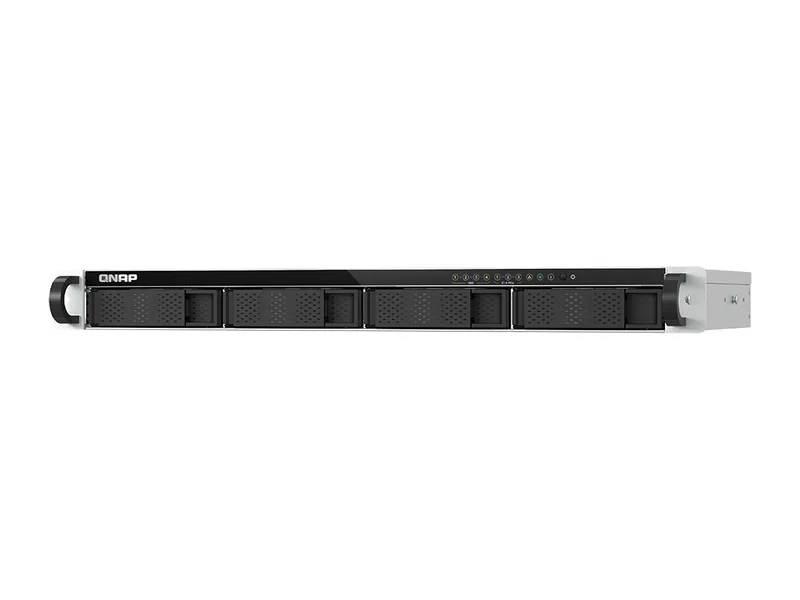
The TS-h765eU suits small offices, media cabinets and wall-mount racks that need a short-depth 1U NAS with light, CPU-only AI on the side. It has 4 SATA bays, 3 E1.S bays, two 2.5GbE ports and a 150W power supply. Memory is 8GB of DDR5 SODIMM, expandable to 16GB, and it supports Docker and virtual machines on QuTS hero or QTS. QNAP confirms Ollama and Open WebUI tutorials for it. Small models fit: Qwen3 8B fits at Q4 (Estimated), and Llama 3.2 3B fits at Q4 and Q8 (Estimated). Qsirch semantic search and QuMagie photo management are vendor confirmed. It carries a 3 year warranty and uses a 4-core Intel Atom x7405C. The AINAS Score is 24, which reflects a file server first and an AI box second.
The limit is memory and the lack of a GPU path. Memory tops out at 16GB, and the TS-h765eU has no PCIe slot, no NPU and no listed integrated GPU, so inference runs on the 4-core Atom CPU only. Anyone planning models of 12B or larger will struggle: Gemma 3 12B is marginal at Q4 (Estimated), and Qwen3 32B does not fit at Q4 (Estimated). Buyers who want private RAG on local models, creative AI or heavier assistants should look for a higher memory ceiling, a PCIe slot that takes a graphics card, or an NPU with a stated TOPS figure. The optional 3 TOPS QAI-M100 and QAI-U100 accelerators are supported, but hardware acceleration is only limited. Buyers happy with small models and file serving are not affected.
Amazon UK
TS-h765eU-8G
£999
Verified
In stock
Buy on AmazonProduct prices and availability are accurate as of the date/time indicated and are subject to change. Any price and availability information displayed on Amazon.co.uk or Amazon.com, as applicable, at the time of purchase will apply to the purchase of this product.
Each capability shows how it was confirmed: Verified by AINAS, Vendor confirmed, Community confirmed or Unverified.
| Capability | Supported | Evidence | Note |
|---|---|---|---|
| Local LLM | Limited | Vendor confirmed | QNAP Ollama guide (x86): 8 GB for 3B, 16 GB for 7B models; 16 GB max, CPU only. |
| Ollama | Yes | Vendor confirmed | Container Station Ollama tutorial for x86_64 QTS/QuTS hero. |
| Open WebUI | Yes | Vendor confirmed | QNAP Open WebUI tutorial, QTS 5.2 / QuTS hero h5.2+. |
| RAG | Limited | Vendor confirmed | Product page: Qsirch with RAG technology using cloud-based LLMs for natural-language search and summaries. |
| AI search | Yes | Vendor confirmed | Qsirch AI Semantic Search needs 64-bit x86 and 8 GB RAM; product page also cites AI OCR and image search. |
| GPU expansion | No | Vendor confirmed | No PCIe slot; no GPUs on compatibility list. |
| Hardware acceleration | Limited | Vendor confirmed | No iGPU listed; QAI-M100 M.2 and QAI-U100 USB accelerators (3 TOPS each) on compatibility list. |
| AI photos | Yes | Vendor confirmed | QuMagie AI-assisted photo management listed under QuTS hero (QTS list shows Photo Station). |
| AI video | Yes | Vendor confirmed | Product page: AI image identification, analysis and search on the NVR side; QVR Face linked. |
| Surveillance AI | Yes | Vendor confirmed | QVR Pro 8 free channels (QTS); QVR Surveillance 2 free + 6 on registration. |
Calculated from the TS-h765eU's memory and each model's published size at each quantization. Rows marked Estimated are calculations, not benchmarks. Check any model.
| Model | Best quantization | Runs? | Memory needed | Expected performance | Verification |
|---|---|---|---|---|---|
| Llama 3.2 3BLlama, 3.21B | Q8 | Yes | 13GB | Not measured | Estimated |
| Llama 3.1 8BLlama, 8.03B | Q5 | Yes | 15GB | Not measured | Estimated |
| Qwen3 8BQwen, 8.19B | Q4 | Yes | 15GB | Not measured | Estimated |
| Gemma 3 12BGemma, 11.8B | Q4 | Marginal | 15GB | Not measured | Estimated |
| Qwen3 14BQwen, 14.8B | Q4 | Marginal | 16GB | Not measured | Estimated |
| Phi-4 14BPhi, 14.7B | Q4 | Marginal | 16GB | Not measured | Estimated |
| Mistral Small 3 24BMistral, 23.6B | None fits | No | 25GB at Q4 | Not measured | Estimated |
| Gemma 3 27BGemma, 27B | None fits | No | 29GB at Q4 | Not measured | Estimated |
| Qwen3 30B A3BQwen, 30.5B | None fits | No | 31GB at Q4 | Not measured | Estimated |
| Qwen3 32BQwen, 32.8B | None fits | No | 32GB at Q4 | Not measured | Estimated |
| DeepSeek-R1 32B (Qwen distill)DeepSeek, 32.8B | None fits | No | 32GB at Q4 | Not measured | Estimated |
| Llama 3.3 70BLlama, 70.6B | None fits | No | 60GB at Q4 | Not measured | Estimated |
| Llama 4 Scout 17Bx16ELlama, 109B | None fits | No | 89GB at Q4 | Not measured | Estimated |
| Qwen2.5 72BQwen, 72.7B | None fits | No | 65GB at Q4 | Not measured | Estimated |
| Mistral Large 2 123BMistral, 123B | None fits | No | 96GB at Q4 | Not measured | Estimated |
One verdict per workload, from the TS-h765eU's use-case scores and capability rows. Unknown means we cannot confirm it, not that it probably works.
Poor for local LLM work. Capability is limited: QNAP's Ollama guide lists 8GB for 3B and 16GB for 7B models, CPU only, and Qwen3 8B fits at Q4 (Estimated) while Gemma 3 12B is only marginal (Estimated).
Poor for private RAG. The RAG row is limited: Qsirch uses cloud-based LLMs for natural-language search and summaries, and local Ollama with Open WebUI is vendor confirmed but held back by 16GB maximum memory and CPU-only inference.
Poor in the fixed rating, though the capability itself is vendor confirmed. Qsirch AI Semantic Search needs 64-bit x86 and 8GB of RAM, which the included memory meets, and the product page cites AI OCR and image search.
Poor as rated, even though QuMagie is listed. QuMagie AI-assisted photo management is vendor confirmed under QuTS hero, while the QTS list shows Photo Station, so the AI feature depends on the operating system and no GPU is listed to help.
Poor in the rating, though surveillance is supported. QVR Pro offers 8 free channels on QTS and QVR Surveillance gives 2 free plus 6 on registration, but the CPU has no NPU or listed GPU for AI analysis.
Poor as rated for a home lab. It does support Docker and virtual machines, but 16GB maximum memory, one SODIMM slot and no PCIe slot limit how much you can run on a 4-core CPU alongside storage.
Poor for business AI work. The 1U short-depth chassis, 4 SATA bays, two 2.5GbE ports and 3 year warranty suit an office, but 16GB maximum memory and no GPU path hold back anything beyond small models.
Poor for creative AI. There is no PCIe slot and no GPU on the compatibility list, and hardware acceleration is limited to the 3 TOPS QAI-M100 and QAI-U100 add-on accelerators, so local models run on the CPU alone.
The TS-h765eU ships with 8GB of DDR5 SODIMM and supports up to 16GB. Upgrading to the maximum lifts the model ceiling from small models up to around 7B parameters to 7B to 8B class models (both Estimated).
As a rule of thumb, a 4-bit model needs about 0.6GB per billion parameters plus room for context. After leaving around 8GB for the NAS operating system, 16GB leaves space for a model of roughly 13B parameters at most (Estimated).
No. The TS-h765eU has no PCIe slot or OCuLink port for a graphics card. Inference runs on the CPU, so keep to small models.
With limits. The TS-h765eU can host a small RAG stack such as AnythingLLM or Open WebUI with a compact embedding model, but memory and compute restrict how large the answering model can be. It suits a personal document library more than a team knowledge base.
The manufacturer also provides AI search across your files (documented by the manufacturer), which covers simple document questions without setting up your own stack.
Networking is 2 x 2.5GbE. Fine for one or two users; indexing a large archive over the network will be slower.
| Configuration | RAM | SSD | Notes |
|---|---|---|---|
| TS-h765eU-8G | 8GB | None |
The closest QNAP model by bay count and AINAS Score. Only the specifications that differ are listed.
The TS-h765eU scores best for Home Lab (29/100) and Business (28/100). It suits home lab owners who want one box for storage, containers, media and a few AI services.
It is a weaker fit for anyone who wants to run models larger than about 8B parameters and for buyers who expect to add a graphics card later.
Other AI Capable systems closest in price.
Buying guides that list it
Yes, at Q4. Qwen3 8B needs 5.2GB at Q4 and fits (Estimated). At Q8 it needs 8.9GB and is marginal (Estimated), which means it loads with little headroom. These are calculations, not benchmarks. Inference runs on the CPU only because the TS-h765eU has no GPU path, and Gemma 3 12B is already marginal at Q4 (Estimated).
Yes. It ships with 8GB and takes up to 16GB in its single DDR5 SODIMM slot, as 1x 16GB. The memory is non-ECC, with in-band ECC support mentioned on the product page. The 16GB ceiling is the limit for local models: Qwen3 32B needs 20GB at Q4 and does not fit (Estimated).
No. The TS-h765eU has no NPU and no listed integrated GPU, so AI work runs on the 4-core Intel Atom x7405C. QNAP's compatibility list names two add-on accelerators instead, the QAI-M100 M.2 module and the QAI-U100 USB unit, each rated at 3 TOPS, and hardware acceleration is rated limited. QNAP's Ollama guide treats this model as CPU only, so language models stay on the Atom: Qwen3 8B fits at Q4 (Estimated), and Gemma 3 12B is marginal at Q4 (Estimated).
Yes. Virtual machines and Docker are both supported on QuTS hero h6.1.0 or QTS 6.1.0. QNAP publishes Container Station tutorials for x86_64 systems. Guests and containers share the 8GB of included memory, which expands to 16GB, and there is no GPU or NPU to hand work to, so heavy workloads will be limited.
No. There is no PCIe slot, and the vendor compatibility list shows no GPUs. There is no Thunderbolt, USB4 or OCuLink port either. The only accelerators supported are the QAI-M100 (M.2) and QAI-U100 (USB), at 3 TOPS each, and hardware acceleration is rated limited rather than fully supported.
4 SATA bays for 3.5in drives, plus 3 E1.S bays for flash storage. M.2 2280 NVMe drives are supported through pre-installed adapters, but those are not hot-swap. The system is a 1U short-depth rackmount unit, so the bay layout is fixed and there is no PCIe slot for adding storage cards.
Yes. Ollama support is documented by the manufacturer. See the capability table above for the source.
Yes. Open WebUI support is documented by the manufacturer. See the capability table above for the source.
Yes. AI photos support is documented by the manufacturer. See the capability table above for the source.
Yes. Surveillance AI support is documented by the manufacturer. See the capability table above for the source.
Partly. Hardware acceleration support is documented by the manufacturer. See the capability table above for the source.
It has 2 x 2.5GbE built in. The fastest port is 2 x 2.5GbE.
Every field records its source. Specifications were last checked on . Spot an error? Send a correction with a manufacturer link.